AT A GLANCE
- The PEG prefix is part of a material’s specification.
- A peptide in a PEG-based carrier is not automatically a PEG-conjugated peptide.
- Related MGF literature needs a careful material match.
One prefix can hide several questions
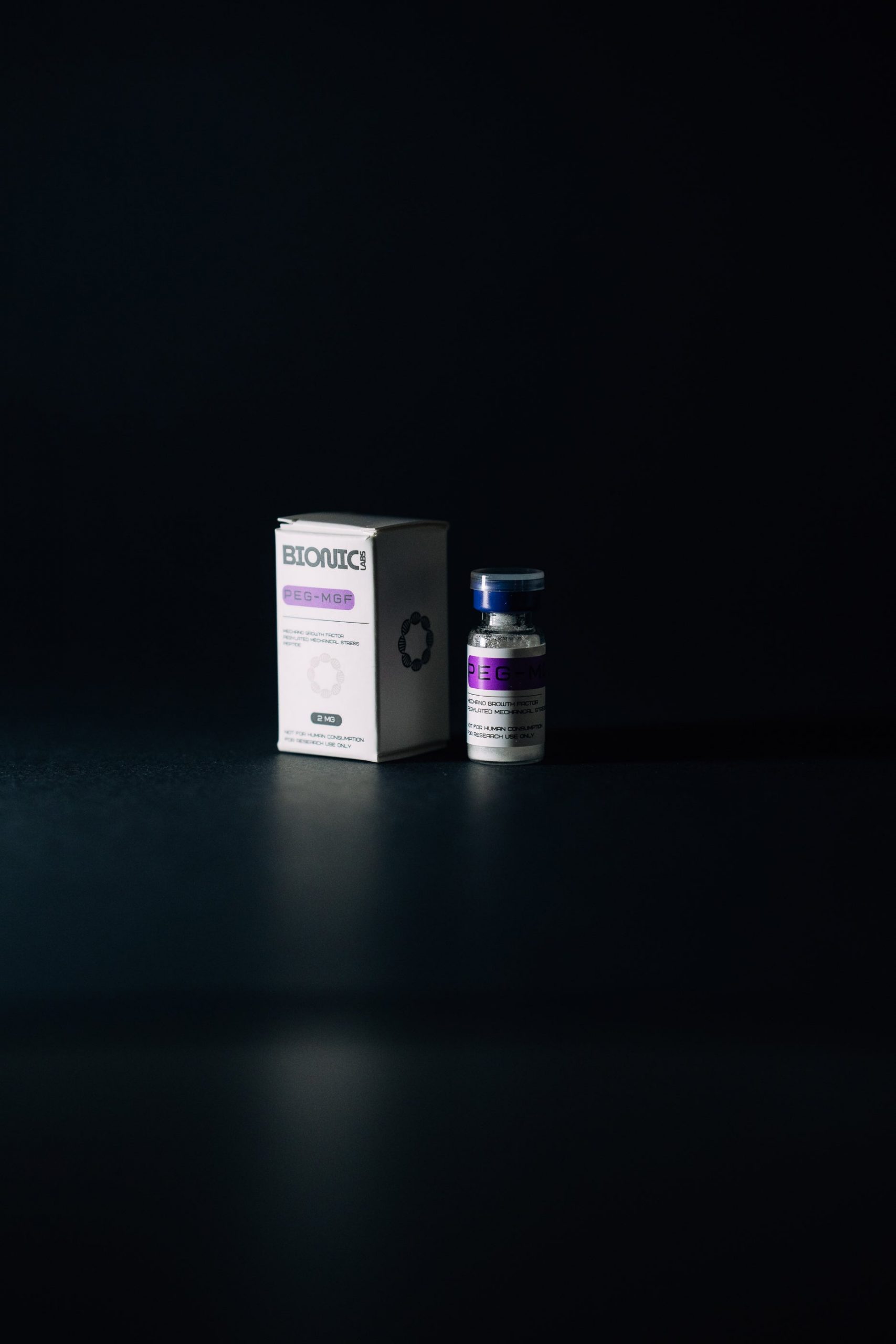
PEG-MGF brings together the name mechano growth factor and a reference to PEG modification. To understand a specific preparation, ask what peptide component is present and how the PEG-related part is defined. A short catalogue name is a useful starting point, but it cannot replace the chemical specification of a modified material.
A delivery study with an important distinction
Peña and colleagues investigated an MGF E-domain peptide delivered through polymeric microstructures in a mouse cardiac model. The microstructures used a PEG-based hydrogel. This is research on a particular delivery approach; it should not be cited as direct validation of every product sold as PEG-MGF. A carrier containing PEG and a PEG-modified peptide are distinct material descriptions. [1]
- 01Peptide component
- 02PEG specification
- 03Delivery or conjugation
- 04Exact material match
Conceptual reading guide — not a biological pathway or an efficacy comparison.
Why the distinction is useful
Imagine comparing two papers that both mention PEG. In one, the peptide might be carried by a surrounding material; in another, the peptide itself may be chemically modified. Even before interpreting the outcome, the first task is to establish what was actually tested. Treating the shared acronym as proof of equivalence would skip that essential step.
Define the amount you are comparing
For a modified material, an amount can be meaningful only alongside its reporting basis. Does the specification refer to the peptide component, the complete conjugate or another defined measure? The answer should come from the supplier’s documentation. The 2 mg label on this catalogue presentation does not, on its own, resolve every question about the composition of the material.
Ask a more precise supplier question
Request the peptide identity, the PEG specification, the basis of the labelled amount and the batch analytical report. If comparing literature, include the exact paper and the part of its methods you want to match. This gives a technical enquiry a concrete purpose and makes it easier to spot a mismatch before treating two materials as equivalent.
| Description | What needs clarification | Useful document |
|---|---|---|
| MGF-derived peptide | Which peptide region or sequence? | Material specification |
| PEG-modified material | What modification is present? | Conjugate specification |
| PEG-based carrier | How is the peptide incorporated? | Study methods |
| 2 mg per vial | What does the amount include? | Batch reporting basis |
Questions, answered.
Does every PEG-related MGF paper study PEG-MGF?
No. Read the methods to distinguish a PEG-based delivery material from a PEG-modified peptide.
Is the labelled amount enough to compare two conjugates?
No. Their composition and reporting basis also need to match.
Sources & further reading
- Peña et al. · Journal of Molecular and Cellular Cardiology · 2015
Primary MGF E-domain peptide delivery study.